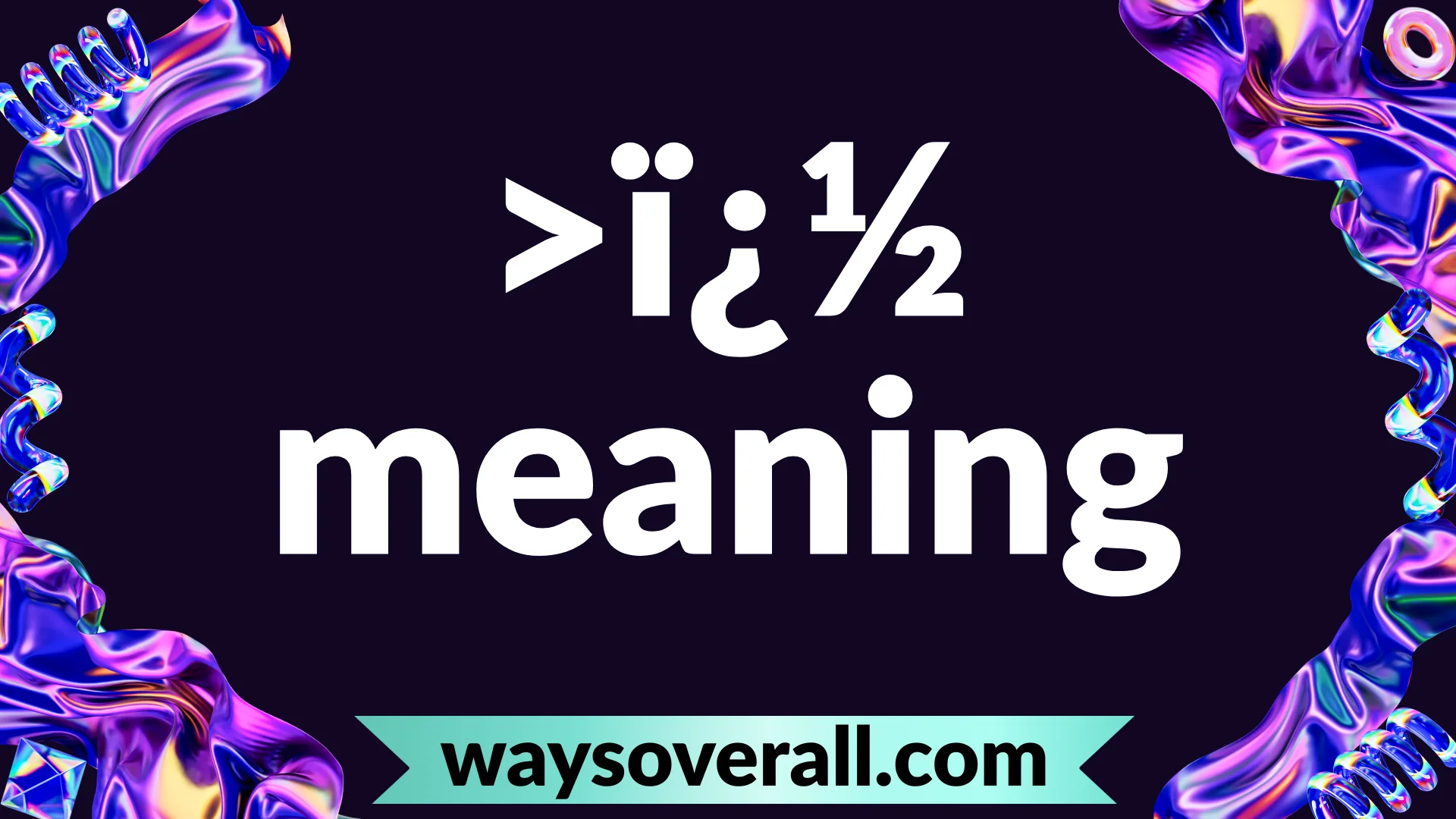
Have you ever seen the strange text >� in a message, website, comment section, or copied document and wondered what it actually means?
You are not alone.
Many people search for >� meaning because it looks confusing, random, and sometimes even suspicious. It does not look like a normal word, emoji, or internet slang. It often appears when text gets copied incorrectly, when a website has an encoding problem, or when symbols break during file transfers.
Sometimes people think it is a secret code, hidden message, or a special internet symbol—but most of the time, it is much simpler than that.
In this guide, we will explain exactly what >� means, where it comes from, how people use it, and how to respond when you see it.
>� Meaning – Quick Meaning
The simplest meaning of >� is:
A broken or incorrectly displayed character caused by text encoding problems.
It usually happens when:
- A website loads text with the wrong character format
- Copy-paste breaks symbols
- Special punctuation gets corrupted
- Emojis or quotation marks fail to display correctly
- Different systems use different language encoding standards
Simple Definition
It is usually not intentional slang, but a technical display issue.
Quick Examples
“Why does my PDF show >� everywhere?”
“I copied the text from Instagram and now it says >� instead of quotes.”
“This email looks broken—it has weird >� symbols.”
In most cases, it means the original text was damaged during display.
Origin & Background
The origin of >� is usually connected to character encoding errors.
When computers store text, they use systems like:
- UTF-8
- ASCII
- Unicode
- ANSI
If one system saves text in one format and another system opens it using the wrong format, symbols can break.
For example:
A smart quote like:
“
may turn into strange symbols like:
�
or
�
This is called mojibake, which means garbled or corrupted text caused by incorrect character decoding.
How It Became Common Online
People often notice this on:
- Social media captions
- Exported PDFs
- Website comments
- Email newsletters
- WhatsApp copied messages
- Old forum posts
Because modern communication moves across many devices, these display issues happen often.
That is why searches for >� meaning continue to grow.
Real-Life Conversations
WhatsApp Chat Example
Person A: Why does your message show >� instead of quotation marks?
Person B: I copied it from a website. I think the formatting broke.
Person A: Oh, I thought it was some secret emoji.
Person B: Nope, just bad copy-paste.
Instagram DM Example
Person A: Your bio says >� at the end. Is that intentional?
Person B: Wait, seriously?
Person A: Yeah, it looks like a weird symbol.
Person B: That must be from editing it on my laptop.
TikTok Comment Example
Person A: Why does the caption have >� everywhere?
Person B: Probably encoding issues.
Person A: I thought it was Gen Z slang.
Person B: Internet problems, not internet slang.
Emotional & Psychological Meaning
Even though >� is usually technical, people often attach emotional meaning to strange symbols.
Why?
Because humans naturally try to find patterns and meaning.
When someone sees an unusual symbol, they may think:
- Is this hidden?
- Is this intentional?
- Does this mean sarcasm?
- Is it a code?
- Is someone trying to be mysterious?
This reflects modern digital behavior: we expect every symbol online to have emotional intent.
In reality, most of the time, >� means nothing emotional at all—but confusion creates curiosity.
That curiosity is why people search for it.
Psychologically, it shows how much trust we place in tiny digital details.
Usage in Different Contexts
Social Media
On social media, >� usually appears by accident.
Examples:
- Broken Instagram bios
- Corrupted TikTok captions
- Facebook posts with formatting issues
People may mistake it for a trend or hidden aesthetic symbol.
Tone
Usually accidental, not expressive.
Friends & Relationships
In texting, strange symbols can create misunderstandings.
Example:
Someone sends:
“I miss you >�”
The other person may think it is emotional or symbolic.
But often, it was supposed to be a heart emoji or special quote.
Tone
Can accidentally feel personal or confusing.
Work or Professional Settings
In professional emails or reports, >� looks unprofessional.
It may suggest:
- formatting mistakes
- file corruption
- poor proofreading
This is where it should be fixed quickly.
Tone
Should be corrected immediately.
Casual vs Serious Tone
Casual
Friends may laugh about it.
“Your phone speaks alien language.”
Serious
In contracts, presentations, and client emails, it can reduce credibility.
Context matters.
Common Misunderstandings
Many people misunderstand >�.
What People Get Wrong
1. Thinking It Is Slang
It usually is not slang.
2. Assuming It Is an Emoji
It often replaces a failed emoji, but it is not one itself.
3. Believing It Is Intentional
Most users do not even know it appeared.
4. Treating It Like a Secret Code
It is normally just broken formatting.
When You Should NOT Use It
Do not intentionally use >� in:
- professional emails
- resumes
- academic writing
- client communication
- official documents
It creates confusion and looks careless.
Comparison Table
| Term | Meaning | Type |
|---|---|---|
| >� | Broken text encoding symbol | Technical issue |
| ??? | Missing or unreadable text | Placeholder |
| � | Replacement character | Encoding error |
| 🙂 | Smiley face | Intentional emoji |
| LOL | Laughing out loud | Slang |
| Clean punctuation | Proper formatting | Correct text |
Key Insight
Unlike slang such as “LOL” or emojis like “:)”, >� is usually accidental, not expressive.
It represents a display problem, not a personality trait.
Variations / Types
1. �
The most common replacement symbol.
Usually appears when text cannot be decoded.
2. ’
Often replaces apostrophes.
Example: don’t instead of don’t.
3. “
Broken opening quotation mark.
Very common in copied articles.
4. â€
Broken closing quotation mark.
Usually appears with the previous variation.
5. >�
A mixed formatting error.
Can happen during email forwarding.
6. ????
Used when the system cannot display symbols.
Looks simpler but means the same issue.
7. □□□
Boxes replacing missing characters.
Often appears in unsupported fonts.
8. é
Broken accented letters.
Example: café becomes café.
9. Random Emoji Fragments
Half-loaded emojis turning into text symbols.
Common in old Android devices.
10. HTML Symbol Errors
Like & or ‘ showing incorrectly.
Usually caused by website coding issues.
How to Respond When Someone Uses It
Casual Replies
- “I think your text broke.”
- “That symbol looks cursed.”
- “Your keyboard is speaking another language.”
Funny Replies
- “Is that a secret hacker code?”
- “Blink twice if >� means help.”
- “Your phone just invented a new language.”
Mature / Confident Replies
- “It looks like an encoding issue.”
- “Your formatting may have changed during copy-paste.”
- “You may want to resend that text.”
Private or Respectful Replies
- “I noticed some characters didn’t display correctly.”
- “Your message may have formatting issues.”
- “Could you resend that part? It seems corrupted.”
Professional situations need respectful responses.
Regional & Cultural Usage
Western Culture
Most people recognize it as a formatting issue, especially in work emails and PDFs.
It is usually treated as a technical problem.
Asian Culture
Because multiple writing systems are used daily, encoding issues are even more common.
People often see broken symbols during translation or platform switching.
Middle Eastern Culture
Arabic-English mixed communication can create display issues often.
Especially when switching between mobile apps and desktop platforms.
This makes strange symbols like >� more noticeable.
Global Internet Usage
Globally, people often assume symbols have emotional meaning.
That is why random formatting errors become searchable terms.
Internet culture turns confusion into curiosity.
FAQs
What does >� mean in texting?
It usually means a formatting or encoding problem, not intentional slang.
Is >� a hidden emoji?
No. It often replaces a failed emoji, but it is not an emoji itself.
Why do I see >� in copied text?
Because the original formatting broke during copy-paste or file transfer.
Is >� bad or offensive?
No. It is normally harmless and accidental.
Can I use >� as slang?
You can, but most people will think it is a mistake.
It is not standard slang.
How do I fix >� symbols?
Use proper UTF-8 formatting, recopy the text, or reopen the file using correct encoding.
Why does it appear in emails?
Emails often pass through multiple systems, which can break special characters.
Conclusion
The real >� meaning is much less mysterious than people expect.
In most cases, it is simply a broken character caused by text encoding issues—not hidden slang, not a secret symbol, and not an emotional message.
Still, because we live in a digital world where every symbol feels important, people naturally search for answers when they see strange text.
That curiosity makes sense.
Understanding symbols like >� helps us communicate better, avoid misunderstandings, and recognize when technology—not emotion—is creating confusion.
Sometimes the strangest messages online are not deep at all.
They are just bad formatting pretending to be meaningful.
────────────────────────────────────────
Discover More Articles
IGH Meaning: What It Really Means in Text, Social Media, and Real Conversations
PTL Meaning: What It Really Means in Text, Social Media, and Real Life
Janky Meaning: What It Really Means and How to Use It Naturally in Real Life
White Heart Emoji Meaning: The Real Emotion Behind (Complete Guide)

I’m Rowan, the author and writer behind this site, personally creating and managing all the content. I explain word meanings, slang, and modern expressions in a simple, easy-to-follow way, using real-life examples to show how language is truly used every day.