If you’ve ever come across the odd-looking text “>�”, you’re not alone. It pops up in messages, websites, captions, or even files—and instantly leaves people confused.
At first glance, it doesn’t look like a word, slang, or even a recognizable symbol. So naturally, people search for it to understand what’s going on.
This guide clears up that confusion. You’ll learn exactly what >� means, why it appears, and how to deal with it in real-life situations.
>� Meaning – Quick Explanation
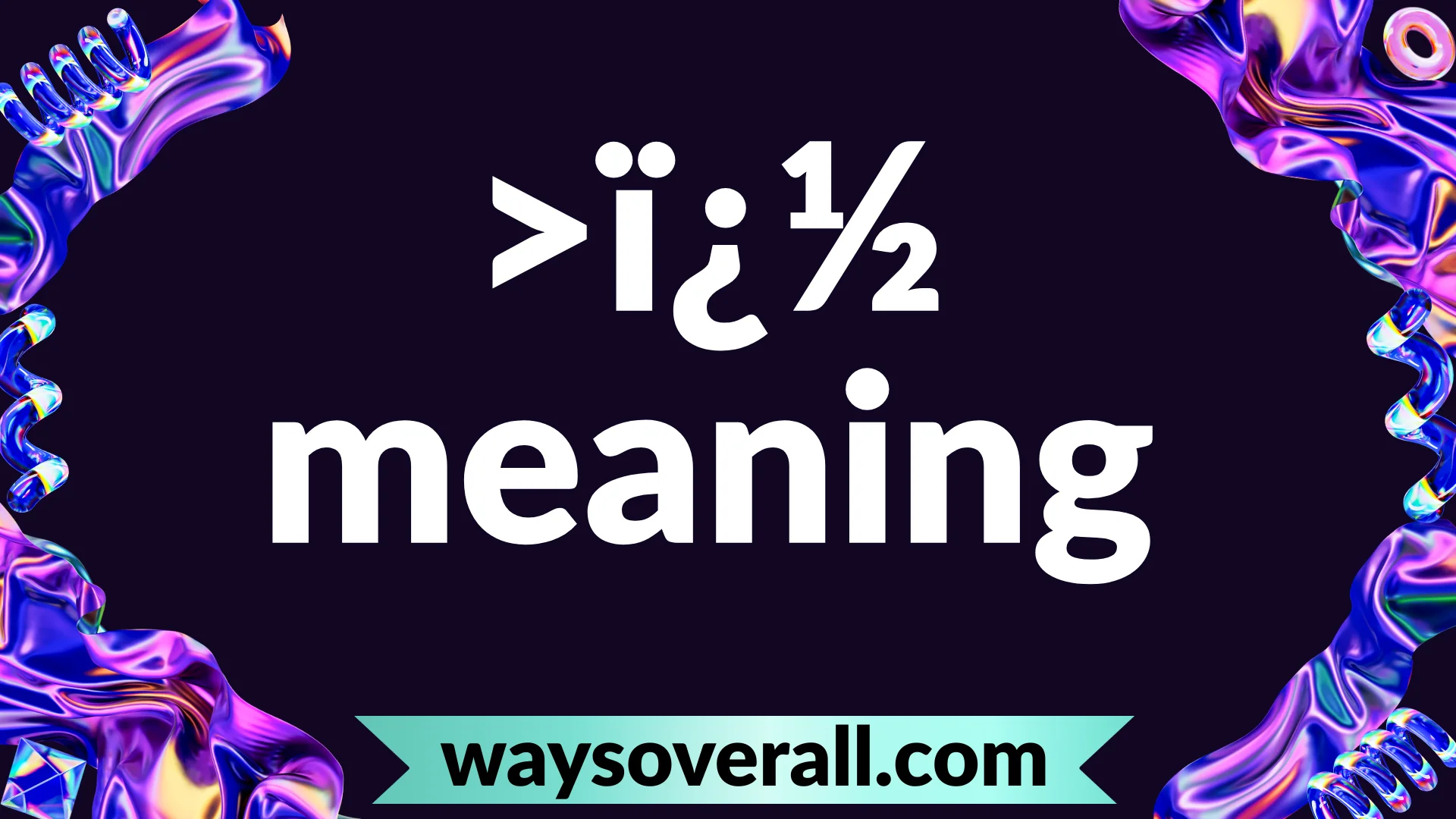
>� is not a real word or intentional symbol.
It’s usually a text encoding error.
Simple definition:
- A broken or misinterpreted character
- Appears when text is not displayed correctly
- Often replaces emojis, symbols, or special characters
Example situations:
- A heart emoji ❤️ turns into
>� - A quotation mark becomes unreadable text
- A copied message loses its formatting
Quick examples:
“I love this >�”
“What does >� mean in this message?”
“My file shows weird symbols like >� everywhere”
Origin & Background
The symbol >� comes from a technical issue called character encoding mismatch.
Here’s what that means in simple terms:
- Computers store text using systems like UTF-8 or ASCII
- When one system reads text using the wrong format, characters break
- Instead of showing properly, they turn into strange symbols like >�
How it evolved:
- Early internet systems had limited character support
- Modern platforms support emojis and global languages
- But when systems don’t align, errors like this appear
Common causes:
- Copy-pasting between apps
- Opening files with the wrong encoding
- Website glitches
- Messaging platform bugs
So while it looks like slang, it’s actually a digital mistake—not intentional language.
Real-Life Conversations
WhatsApp Chat
Person A:
Why does your message show “>�” at the end?
Person B:
Oh, I sent a heart emoji. Must’ve glitched.
Instagram DMs
Person A:
What’s that weird symbol in your bio?
Person B:
Which one?
Person A:
“>�” after your quote
Person B:
That’s supposed to be a sparkle emoji 😅
TikTok Comments
User1:
Why do I see “>�” instead of emojis?
User2:
It’s your device or app glitching
Emotional & Psychological Meaning
Even though >� isn’t a real word, it still triggers reactions.
Why people notice it:
- It interrupts understanding
- It feels like something is “missing”
- It creates confusion or curiosity
Emotional impact:
- Mild frustration (“Why is this broken?”)
- Curiosity (“What was supposed to be here?”)
- Disconnection (especially in emotional messages)
Imagine someone sends:
“I’m proud of you >�”
You instantly feel something is off. That missing symbol might have been a heart, hug, or smile—changing the emotional tone completely.
So while it’s technical, its impact is very human.
Usage in Different Contexts
1. Social Media
- Appears in captions, bios, or comments
- Usually replaces emojis or symbols
- Often caused by platform compatibility issues
2. Friends & Relationships
- Can make messages feel incomplete
- Misinterpretation is common
- Emotional tone may get lost
3. Work or Professional Settings
- Seen in emails or documents
- Makes content look unprofessional
- Often due to formatting or file issues
4. Casual vs Serious Tone
- Casual: People ignore or joke about it
- Serious: Needs fixing (especially in formal communication)
Common Misunderstandings
1. Thinking it’s slang
Some people assume >� is a hidden meaning or code—it’s not.
2. Assuming it’s intentional
Most of the time, the sender didn’t even notice it.
3. Believing it has a fixed meaning
It doesn’t. Its meaning depends on what was originally there.
When NOT to ignore it:
- In professional emails
- In important documents
- In customer-facing content
Comparison Table
| Term / Symbol | Meaning | Usage Type | Clarity |
|---|---|---|---|
| >� | Encoding error | Unintentional | Confusing |
| 🙂 | Smiley emoji | Emotional expression | Clear |
| ??? | Confusion | Intentional | Moderate |
| � (replacement char) | Unknown character | Technical | Low clarity |
| ❤️ | Love/affection | Emotional | Very clear |
Key Insight:
Unlike real symbols or emojis, >� has no meaning by itself—it only signals that something went wrong.
Variations / Types
Here are similar broken or corrupted text forms:
- � (replacement character)
Appears when a character can’t be displayed - é instead of é
Encoding mismatch in accented letters - 😂 instead of 😂
Emoji encoding error - ???
Missing or unreadable text - □ (empty box)
Unsupported character - & instead of &
HTML not rendered properly - %20 in text
URL encoding showing up - \uXXXX codes
Unicode not decoded - Random symbols like ’
Misread punctuation - Broken emoji strings
Partial emoji display
How to Respond When Someone Uses It
Casual Replies
- “I think your message glitched 😅”
- “That symbol didn’t load properly”
Funny Replies
- “Is that a secret code or your phone acting up?”
- “Your message came with a mystery symbol 😂”
Mature / Confident Replies
- “I believe that part didn’t display correctly. Could you resend it?”
Private / Respectful Replies
- “Hey, I think there’s a formatting issue in your message”
Regional & Cultural Usage
Western Culture
- Recognized as a tech glitch
- Often ignored or joked about
Asian Culture
- More noticeable due to complex character systems
- Encoding issues are more common across platforms
Middle Eastern Culture
- Appears when Arabic text isn’t properly supported
- Can disrupt meaning significantly
Global Internet Usage
- Common across all platforms
- Seen as a universal “error symbol”
- Not tied to any specific language
FAQs
1. What does >� mean in text?
It usually means a character or emoji failed to display correctly due to encoding issues.
2. Is >� a symbol or slang?
No, it’s not slang. It’s a technical error.
3. Why do I see >� instead of emojis?
Your device or app may not support the encoding used.
4. Can I fix >� in my messages?
Yes—try updating your app, changing encoding settings, or resending the message.
5. Is >� dangerous or harmful?
No, it’s harmless. Just a display issue.
6. Does it have a hidden meaning?
No. It only replaces something that failed to load.
7. Why does it appear in files?
Because the file was opened with the wrong encoding format.
Conclusion
At first glance, >� looks like a mysterious symbol, but in reality, it’s just a digital miscommunication.
It doesn’t carry meaning on its own—it represents something that didn’t display properly. Whether it’s an emoji, symbol, or special character, the original intent gets lost in translation.
Understanding this helps you avoid confusion, respond appropriately, and fix issues when they matter—especially in professional or emotional conversations.
In a world where communication is increasingly digital, even small glitches like this remind us how important clarity really is.
Discover More Articles
WYF Meaning: What It Really Means in Text, Social Media & Real Conversations
Cap Slang Meaning: What “No Cap” Really Means and How to Use It Naturally
WYA Meaning: What It Really Means, How to Use It, and Why Everyone Says It
GNG Meaning: What It Really Means in Text, Slang & Everyday Conversations

I’m Rowan, the author and writer behind this site, personally creating and managing all the content. I explain word meanings, slang, and modern expressions in a simple, easy-to-follow way, using real-life examples to show how language is truly used every day.