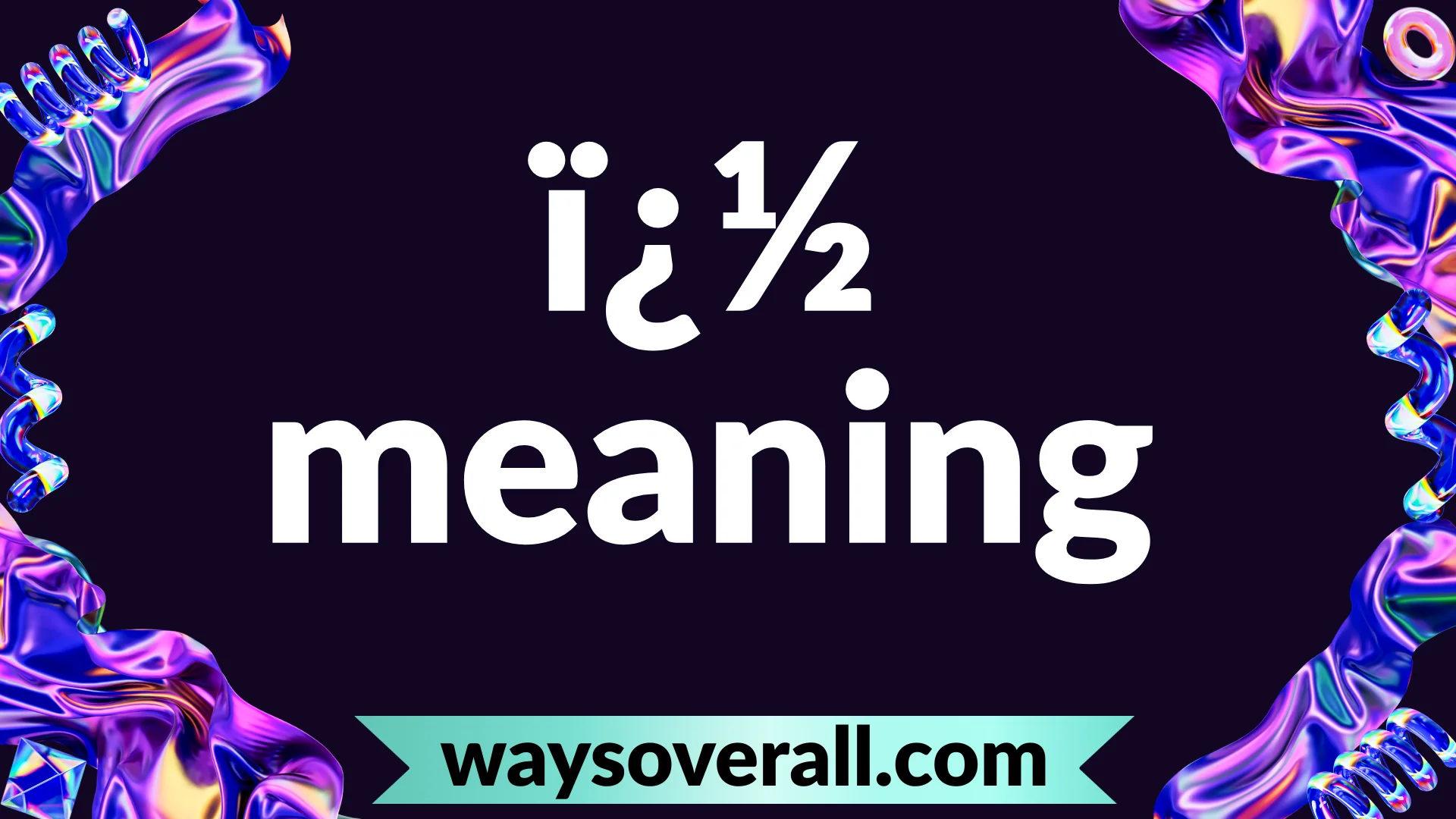
If you’ve ever come across the symbol � while browsing a website, opening a file, or scrolling through messages, you’re not alone. It looks confusing, out of place, and honestly—kind of annoying.
Most people search for “� meaning” because they assume it’s a hidden symbol, a special character, or even some kind of code. But the truth is a bit different—and much more practical.
This article clears up the confusion, explains exactly what � means, and shows you why it appears in real-life situations across devices, apps, and platforms.
� Meaning – Quick Definition
� is not a real symbol with a meaning. It is a replacement character that appears when a system cannot correctly display a character.
In simple terms:
- It means “something went wrong here.”
- It replaces unreadable or corrupted text
- It signals an encoding error
Example:
“I love you �”
(The original emoji or symbol failed to load)
“Price: 50�”
(Currency symbol didn’t display correctly)
“Welcome to our site � enjoy!”
(Special character missing)
Origin & Background
The symbol � comes from a deeper technical concept called character encoding.
Every letter, symbol, or emoji you see on a screen is stored as a number behind the scenes. Systems like UTF-8 encoding are designed to translate those numbers into readable text.
When something breaks in that process—like:
- A file saved in one format but opened in another
- A website using incorrect encoding
- Data getting corrupted
…the system doesn’t know what to display. So it inserts a replacement character, often shown as �.
Originally, this symbol comes from the Unicode standard and is meant to represent “unknown or invalid character.”
Over time, it became more visible because of:
- Global internet usage
- Mixing languages and character sets
- Emojis and special symbols becoming common
Real-Life Conversations
WhatsApp Chat
Person A:
Why is your message full of weird symbols?
Person B:
Wait what? Oh no… I see “�” everywhere 😭
Person A:
Yeah, your emojis didn’t load properly.
Instagram DMs
Person A:
That caption looked broken… it had “�” in it.
Person B:
Oh wow, probably copied from another app. Encoding issue I guess.
TikTok Comments
User 1:
Why does this comment say “���”?
User 2:
That’s what happens when text gets corrupted lol.
Emotional & Psychological Meaning
Even though � has no emotional meaning by itself, people react to it in very real ways.
Why it frustrates people:
- It interrupts readability
- It creates confusion
- It makes content look broken or unprofessional
What it reflects:
- A gap in communication
- A technical failure in expression
- The feeling of “something missing”
In a digital world where clarity matters, seeing � can feel like losing part of the message.
Usage in Different Contexts
1. Social Media
You’ll often see � when:
- Emojis fail to load
- Text is copied between apps
- Fonts aren’t supported
Example:
“Best day ever �” (emoji missing)
2. Friends & Relationships
In chats, it can lead to misunderstandings:
- A joke loses its punch
- A romantic message loses its tone
3. Work & Professional Settings
In emails or documents:
- It looks unprofessional
- It signals formatting issues
- It may confuse clients or readers
4. Casual vs Serious Use
- Casual: People ignore it or joke about it
- Serious: It must be fixed immediately
Common Misunderstandings
❌ “It’s a secret symbol”
No, it’s just an error placeholder.
❌ “It has a hidden meaning”
It doesn’t—it replaces something unknown.
❌ “It’s a virus or hack”
Not at all. It’s a display issue.
⚠️ When meaning changes:
Sometimes it replaces:
- Emojis
- Currency symbols
- Accented letters
So the original meaning is lost, not transformed.
Comparison Table
| Term / Symbol | Meaning | Usage |
|---|---|---|
| � | Unknown/replacement character | Encoding error |
| ? | Question mark | Asking something |
| □ (box symbol) | Missing font character | Display issue |
| … | Ellipsis | Pause or continuation |
| Emoji (😊) | Emotional expression | Social communication |
Key Insight:
� is not intentional communication—it’s a failure of communication.
Variations / Types
Here are common ways this issue appears:
- � (single symbol)
One character failed to load - ��� (multiple symbols)
Entire word or phrase corrupted - Black diamond with question mark
Another visual version of replacement character - Boxes (□)
Font not supported - ???
System fallback when decoding fails - Broken emoji display
Emoji replaced with � - Currency errors (� instead of € or ₹)
Encoding mismatch - Accent letter issues (é instead of é)
Misinterpreted encoding - Mixed language corruption
Happens with multilingual text - File import errors
Seen in CSV or Excel files
How to Respond When Someone Uses It
Casual Replies
- “Looks like your text broke 😄”
- “That ‘�’ is suspicious lol”
Funny Replies
- “Ah yes, the ancient symbol of confusion”
- “Did your keyboard just give up?”
Mature / Confident Replies
- “Your message didn’t display properly—maybe resend it?”
- “I think there’s an encoding issue in your text.”
Private / Respectful Replies
- “Hey, part of your message didn’t come through clearly.”
- “Can you resend that? Some characters didn’t load.”
Regional & Cultural Usage
Western Culture
- Seen as a technical glitch
- Often ignored or quickly fixed
Asian Culture
- More noticeable due to complex character systems
- Appears when switching between language formats
Middle Eastern Culture
- Common when mixing Arabic and English text
- Encoding issues can affect readability significantly
Global Internet Usage
- Universal symbol of broken text
- Recognized by developers, writers, and everyday users
FAQs
1. What does � actually mean?
It represents an unknown or unreadable character due to encoding errors.
2. Is � a real symbol?
No, it’s a placeholder used when text cannot be displayed correctly.
3. Why do I see � in messages?
Because the original text or emoji failed to load or decode properly.
4. How do I fix � errors?
Use proper encoding (like UTF-8) and avoid copying text between incompatible formats.
5. Is � harmful?
No, it’s harmless—just a display issue.
6. Does it affect SEO or websites?
Yes, it can hurt readability and user experience if not fixed.
7. Why does it replace emojis?
Because emojis require proper encoding support—if missing, they break.
Conclusion
The symbol � might look mysterious, but it’s actually very simple—it’s a sign that something didn’t translate correctly.
It doesn’t carry emotion, intention, or hidden meaning. Instead, it reflects a technical gap in communication, where the system couldn’t deliver the original message properly.
Understanding this helps you:
- Avoid confusion
- Fix errors faster
- Communicate more clearly online
Next time you see �, don’t overthink it. Just know:
something was meant to be there—but didn’t make it through.
Discover More Articles
>� Meaning: What This Strange Symbol Really Means and Why You’re Seeing It Everywhere
WYF Meaning: What It Really Means in Text, Social Media & Real Conversations
Cap Slang Meaning: What “No Cap” Really Means and How to Use It Naturally
WYA Meaning: What It Really Means, How to Use It, and Why Everyone Says It

I’m Stanley, the writer behind this website, handling and publishing all the content myself. I break down word meanings, slang, and modern expressions in a clear and easy-to-understand way, using practical, real-world examples to show how language is actually used in everyday life.